
<p>I'll be honest: I know very little about opera. But there's one opera voice I'd recognise anywhere, and I suspect you would too. It's Montserrat Caballé singing "Barcelona" with Freddie Mercury, the song chosen for the 1992 Olympic Games.</p>
<p>So I was delighted to see that <strong><em>Caballé</em></strong>, a new film about her life, has won <strong>two awards</strong> at the <strong>Tallinn Black Nights Film Festival</strong> in Estonia. And it wasn't the only film with Spanish involvement to come home with a prize.</p>
<h3>A festival of long nights</h3>
<p>The festival, known locally as PÖFF, held its 30th edition from 6 to 22 November. Its name comes from the very long, dark nights of the Baltic winter.</p>
<p>It is one of the world's <strong>"A-list" festivals</strong>, the top category recognised by the international federation of film producers, alongside Cannes, Berlin and Venice. The awards were announced on 20 November.</p>
<h3><em>Caballé</em>: from post-war Barcelona to the opera house</h3>
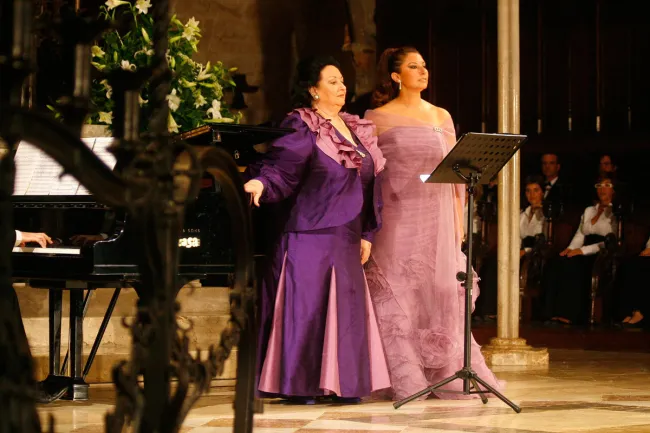
<p>The film is directed by <strong>Patricia Ortega</strong>, a Venezuelan-born director based in Spain. It moves between two moments in the life of Montserrat Caballé, who lived from 1933 to 2018.</p>
<p>We see her youth in a poor family in post-war Barcelona, under pressure to be the one who would rescue them. And we see her in 1991, already a world-famous diva, returning to sing in her home city.</p>
<p>Two actors share the role: Ana Saavedra plays the young Caballé, and Begoña Alberdi, herself a soprano, plays her as an adult. Scenes were filmed in Bilbao and at Barcelona's famous opera house, the Gran Teatre del Liceu.</p>
<p>In Tallinn the film won two craft awards:</p>
<ul>
<li><strong>Best Original Score</strong>, for the composer <strong>Beatriz López-Nogales</strong>. The score is the music written specially for a film.</li>
<li><strong>Best Production Design</strong>, for <strong>Vanesa de la Haza</strong>. Production design is the work of creating the sets, locations and objects you see on screen.</li>
</ul>
<p>I love that a film about a singer was rewarded for its music. And recreating both 1940s and 1991 Barcelona is no small task.</p>
<p><em>Caballé</em> is a <strong>co-production</strong> between Spain and Belgium, meaning companies from both countries funded and made it. It has no UK or Spanish release date yet.</p>
<h3><em>La Pietà</em>: when a glacier is the main character</h3>
<p>The second Spanish-linked winner is <strong><em>La Pietà</em></strong>, by <strong>Pepe Andreu and Rafa Molés</strong>, which won Best Film in the festival's Baltic documentary competition. It's a co-production between Spain, Iceland and Lithuania.</p>
<p>It tells the story of seven Icelandic brothers and sisters who chose to live in isolation at the foot of Europe's largest glacier. They explored it and almost worshipped it, long before anyone talked about melting ice. Today their farm stands empty, and the glacier is shrinking.</p>
<p>The directors wanted the glacier to be a character in its own right, not just a pretty background. For me, that idea is what makes the film stand out. It is already showing in Spain, so keep an eye out for it at documentary festivals and on streaming services.</p>
<h3><em>One Month</em>: the critics' choice</h3>
<p>The third film with Spanish involvement is <strong><em>One Month</em></strong>, by the Bulgarian director <strong>Maya Vitkova-Kosev</strong>, made by Bulgaria, Romania and Spain together.</p>
<p>It won the <strong>Critics' Picks</strong> competition, a section chosen by film critics. Vitkova-Kosev made history with her first feature, <em>Viktoria</em>: it was the first Bulgarian film ever to compete at the Sundance Film Festival.</p>
<h3>And the top prize went to a Spanish-language film</h3>
<p>The festival's main award, the <strong>Grand Prix for Best Film</strong>, went to <strong><em>On Top of the Cliff</em></strong>, by the Peruvian director <strong>Enrica Pérez</strong>. It's a co-production between Mexico, Peru and Switzerland.</p>
<p>The film is a suspense thriller with a touch of fantasy, set in a Catholic girls' school. Its star, <strong>Bianca Bucelli</strong>, also won Best Actress.</p>
<h3>What it all tells us</h3>
<p>Hardly any of these films comes from a single country. To me, that's the real story: more and more European films are made by partners across borders, and Spanish talent is all over them.</p>
<p>Anyone who reads the credits of today's European films can see it. Spanish names turn up in the music, the design, the documentaries and the production, not just in front of the camera.</p>
<p>So, while we wait for <em>Caballé</em> to reach cinemas, I have a suggestion: put "Barcelona" on, as loud as your neighbours will allow.</p>
<hr>
<p><em>A note on this article: awards and details were correct at the time of writing; release dates may change and vary by country.</em></p>
Caballé, the Montserrat Caballé biopic, wins two awards at Tallinn Black Nights Film Festival. The Spanish co-productions that won.