
Coffee with Javier Marías
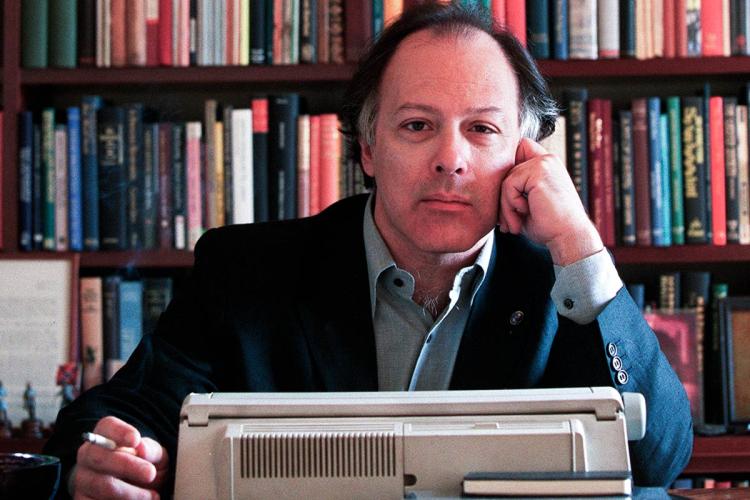
A review of Aquí me paro, the posthumous collection of more than sixty texts by Javier Marías written between 2001 and 2020, which reads as an intellectual self-portrait of the author of A Heart So White.
LinkMyriam BO
Four years ago, the Spanish writer Javier Marías died, leaving a literary legacy of sixteen novels —among them The Man of Feeling, A Heart So White, Tomorrow in the Battle Think on Me and The Infatuations— as well as 23 collections of articles and essays, prologues and short pieces scattered across newspapers, magazines and occasional publications. His work has been published in forty-six languages and fifty-nine countries, with nine million copies sold.
Recently, his publisher has gathered more than sixty texts written between 2001 and 2020, more than a dozen of which had never been published in Spanish. Aquí me paro reveals the many, often unknown, facets of one of the essential names in recent literature.
Some of these writings had been scattered across periodicals or had appeared in books published in other languages. The author himself had conceived the project of bringing this material together in 2020, a plan left unfinished by his death in September 2022.
The result is much more than a compilation of scattered pieces: Aquí me paro can be read almost as an intellectual self-portrait. The book is organised into seven broad territories: autobiographical memories; reflection on his own work and the creative process; politics and society; cinema and television series; football; literature and the writers who shaped his world; and tributes to figures he admired. To these is added, as an appendix, the statement with which he rejected, in 2012, the National Narrative Prize awarded to The Infatuations.
In these pages we meet the most intimate Javier Marías, returning to childhood, family and memory; the novelist who tries to explain —and often declares himself unable to explain— where a novel comes from and how its writing progresses; the reader of Shakespeare, Cervantes, Quevedo, Conrad, Lampedusa and Juan Benet; the passionate viewer capable of thinking about the world through John Ford or The Sopranos; and the football fan who turns a match, a player or a memory of Real Madrid into material for reflecting on time, emotion, loyalty or loss.
But one of the greatest attractions of Aquí me paro lies in seeing the extraordinary relevance of many of his observations. Written ten, fifteen or more than twenty years ago, many of the texts seem to speak directly to the present.
In 2011 he wrote about a present in which the duration of things was shrinking "at breakneck speed", to the point that a film, a piece of music or a book seemed to become past from the very moment of its appearance. And in another text he observes an ever more "shouty" and exhibitionist world, saturated with come-ons, information and overexposure, in which the individual's attention and capacity for concentration are necessarily limited. Read from our own present, these pages take on a resonance that is hard to ignore.
Aquí me paro thus confirms that Javier Marías was not only one of the great contemporary Spanish novelists, but also an intellectual deeply attentive to the mechanisms by which we tell and interpret. His thought never separates entirely from literature: even when he talks about politics, football, cinema or everyday life, his gaze turns towards language, memory, time, fiction, individual responsibility and the contradictions of human behaviour.
For those who know his work, the book offers a reunion with his intelligence, his irony, his independence of judgement and an immediately recognisable prose, as well as access to a hitherto scattered area of his writing. For those who have read his novels, it offers a privileged way into the thinking that accompanies and illuminates them.
Honours
In 1997 he received the Nelly Sachs Prize; in 1998, the Comunidad de Madrid Prize; in 2000, the Grinzane Cavour and Alberto Moravia prizes; in 2008, the Alessio and José Donoso prizes; in 2010, The America Award; in 2011, the Nonino Prize and the Austrian State Prize for European Literature; in 2012, the Terenci Moix Prize; in 2013, the Formentor Prize; in 2015, the Bottari Lattes Grinzane Prize; and in 2017, the Liber Prize, all of them for his body of work.