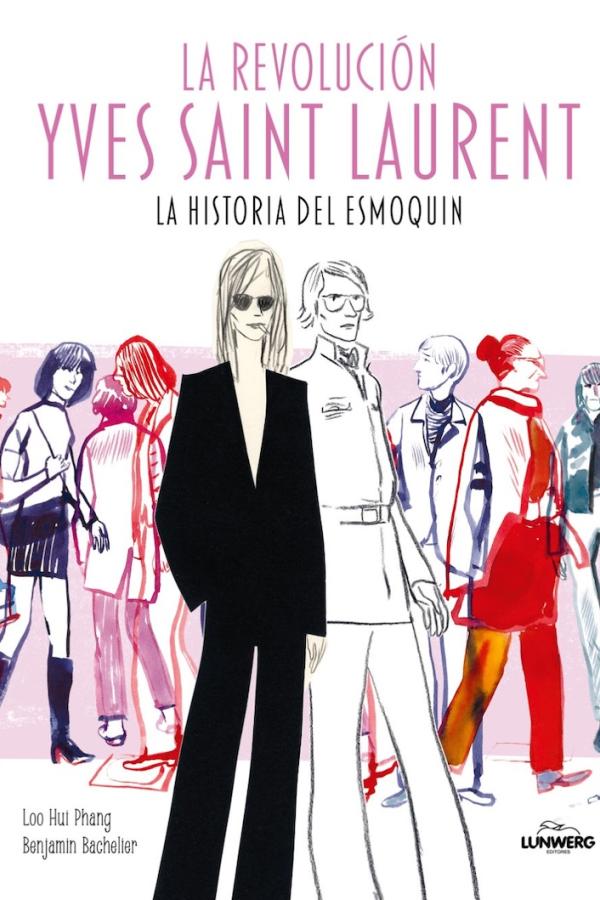
The man behind the woman's tuxedo
The Yves Saint Laurent Revolution, a graphic novel about how the designer turned the women's tuxedo into a symbol of emancipation.
LinkMyriam BO
The Yves Saint Laurent Revolution:: The Story of the Tuxedo (La revolución Yves Saint Laurent: historia del esmoquin) by Loo Hui Phang and Benjamin Bachelier. This graphic novel tells the story of the great designer Yves Saint Laurent and how, starting with the tuxedo, he transformed fashion into a tool for female liberation, leaving a profound mark on contemporary culture.
The Origin
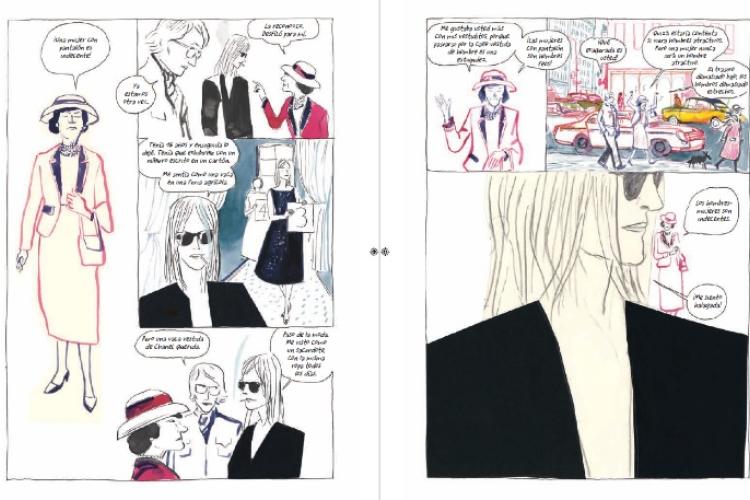
It was Paris in 1966. In his studio on Avenue Marceau, Yves Saint Laurent was preparing his new collection. From his sketches emerged a female figure… wearing a tuxedo! A year later in New York, Yves Saint Laurent went out to lunch on the Upper East Side with Betty Catroux, his lifelong muse. No restaurant would give them a table… because Betty was wearing a tuxedo. A woman in trousers?
Through Yves Saint Laurent and Betty Catroux's stroll through the streets of New York, we will witness the revolution that the women's tuxedo represented, becoming a symbol of social change, power, and femininity.
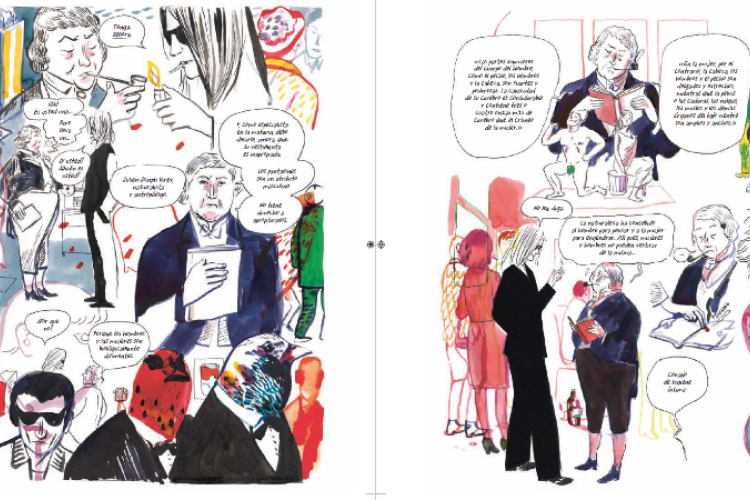
The book explores how the fashion designer transformed a traditionally masculine garment into a symbol of women's emancipation through the life and creative universe of Yves Saint Laurent. This biography, presented as a graphic novel, offers a deeper understanding of the designer.
The Tuxedo as a Symbol of Social Change
In the 19th century, it was considered indecent for women to wear a closed garment. Prohibiting women from wearing trousers wasn't just about aesthetics, but also a way of denying them power and autonomy. Denying them trousers meant depriving them of "the same status and the same functions as men," a restriction linked to laws, customs, and social codes that protected male power.
Saint Laurent wanted to redefine the female body from a different perspective. The book reiterates that it wasn't a simple "cut and paste" of the men's suit, but a reinterpretation that combined modernity, transgression, and elegance. It also emphasizes that his tuxedos had to allow for real movement: walking, dancing, living. This idea is key because it connects with a central feminist demand: that clothing should serve a woman's body and her life, not the other way around.
The designer transformed an elite men's garment into a tool of symbolic emancipation for women. He didn't single-handedly resolve the feminist struggle, but he did contribute to a historical shift: the transition from the decorative woman to the active, visible, confident woman in control of her body. Within this framework, Yves Saint Laurent took the tuxedo, a garment that symbolizes absolute power, and adapted it to the female form. This completely challenged the idea that femininity had to be fragile.
Who was Yves Saint Laurent?
Born in 1936, he was a visionary French fashion designer who left an enormous mark on the industry with his bold approach, boundless creativity, and the elegance of his creations. Known for his revolutionary contributions to the world of fashion, Saint Laurent became an icon whose influence continues to this day. From his early days at the House of Dior, where he began working at a very young age, Yves Saint Laurent demonstrated extraordinary talent and an innate intuition for fashion. His audacity and unique vision led him to break with established conventions, transforming the way women dressed and how they perceived themselves. Among his most significant achievements was his "Mondrian" collection in 1965. Inspired by the abstract art of Piet Mondrian, Saint Laurent created a series of garments that fused fashion and art in striking ways. His geometric and colorful dresses and ensembles became an avant-garde expression of fashion, challenging the traditional limitations of garment design.
Another revolutionary contribution by Saint Laurent was the introduction of the women's tuxedo in his "Le Smoking" collection in 1966. Saint Laurent transformed an exclusively masculine garment into an elegant and provocative option for women, redefining the notions of femininity and power in fashion. His ability to challenge gender norms and his understanding of sexuality secured him a prominent place in fashion history. Yves Saint Laurent's influence on fashion was also reflected in his focus on comfort and functionality. He introduced the "Rive Gauche" line, which offered high-quality ready-to-wear garments, democratizing haute couture and making it accessible to a wider audience. This innovation changed the dynamics of fashion and paved the way for contemporary fashion as we know it today.
The authors
Through comics, theater, film, novels, installations, and performances, Loo Hui Phang reflects on the question of storytelling. The Angoulême International Comics Festival dedicated a first exhibition to her in 2017, showcasing her entire body of work, titled "Synoptique" [Synoptic], and a second in 2022, titled "Écrire est un métier" [Writing is a Craft].
Benjamin Bachelier entered the world of comics in 2006 with the series Le Legs de l’Alchimiste (Glénat). His talent as a painter, characterized by his masterful color harmonies, is fully expressed through his numerous novel adaptations (The Great Gatsby - Norma Editorial; Legends of the Otori - Tengu Ediciones). In 2023, Futuropolis published Oliphant, the first collaboration between the artist and screenwriter Loo Hui Phang.