
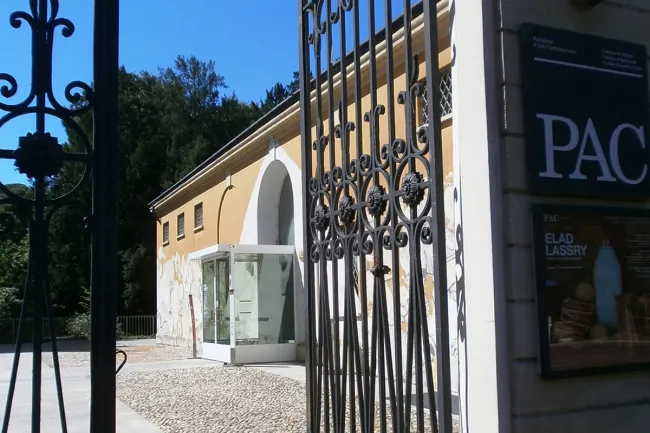
More than 100 works, a new piece in the park and a friendship that began in 1962. The PAC's show runs until 14 February 2027.
I'll admit something. For years I thought of textiles as the stuff of cushions and curtains: lovely, useful, but not quite art. Then I stood in front of a wall of wrapped, knotted, brightly coloured thread by Sheila Hicks, and had to rethink a few things.
Milan is now giving everyone the same chance. The PAC, the city's Pavilion of Contemporary Art, has opened Sheila Hicks: In the Thread of Love, the first Sheila Hicks retrospective ever held in Italy.
A retrospective is an exhibition that looks back over an artist's whole career, from the early pieces to the latest. This one has plenty to look back on: Hicks is 92, and she was there in person for the opening.
Who is Sheila Hicks?
Hicks was born in Hastings, Nebraska, in 1934. She studied art at Yale under Josef Albers, the painter famous for his studies of how colours change when you put them side by side.
In 1957 a Fulbright grant, a US scholarship for studying abroad, took her to Chile to paint. In South America she became fascinated by fibres and weaving. She has lived and worked in Paris since 1964.
Today she is seen as a pioneer of fibre art. In plain terms, that means art made from thread, yarn, cloth and other fibres. They're shaped into sculptures and wall pieces rather than things to wear or sit on. Her materials range from linen and silk to slate, and even old military and nurses' uniforms.
What can you see at the PAC?
The show brings together more than 100 works, from pieces that fit in your hand to installations that fill a room. Some have never been shown before.
They come from major collections around the world: MoMA in New York, the Philadelphia Museum of Art, the Pérez Art Museum Miami, the Stedelijk Museum in Amsterdam, the Josef Albers Museum Quadrat in Bottrop, the Museum of Decorative Arts in Prague and the National Museum in Oslo.
The curator, Diego Sileo, put the show together in close collaboration with Hicks herself. Visitors are greeted in the first room by Escalade Beyond Chromatic Lands, a huge piece she made for the 2017 Venice Biennale.
Why does Milan matter to her?
This is the part of the story I find most moving. In 1962, Hicks met the Italian painter Piero Dorazio in Milan. He was known for canvases criss-crossed with bands of colour. She recognised in him a rare feeling for colour, and the friendship shaped her work for years.
That meeting now has its own space. The PAC's Project Room, a smaller side gallery, is showing Sheila Hicks / Piero Dorazio. Interlacing Colours, which puts the two artists side by side.
Outside, in the park of the Villa Reale next door, Hicks has made a new site-specific work, Homage to Piero Dorazio (2026). Site-specific means it was created for that exact spot. It's meant to be seen there and nowhere else.
Why is this exhibition important now?
For a long time, working with thread was filed under craft rather than art. Hicks spent nearly seventy years proving that label wrong.
Most of us only notice weaving when it's finished, as a scarf or a rug; Hicks makes you look at how it's built: the warp, the threads stretched tight lengthwise, and the weft, the thread passed over and under them. She uses them the way a painter uses brushstrokes.
That's the real pleasure of this show. You don't need to know anything about art history to enjoy it. Colour, texture and scale do the talking.
The good news: there's still time
The exhibition runs until 14 February 2027, Valentine's Day, a neat fit for a show called In the Thread of Love. So there's room to plan a winter weekend in Milan around it.
You'll find the PAC at via Palestro 14, a short walk from the city centre. Check the PAC website for opening hours and tickets before you go.
And if, like me, you've always walked past textiles in museums, this might be the show that makes you stop.
Exhibition details were correct at the time of writing; please check with the PAC before you travel.
Lead image: PAC (Padiglione d'Arte Contemporanea), Milan, by Stefano Stabile, CC BY-SA 3.0, via Wikimedia Commons. Cropped.