
A mixed reality exhibition in Suffolk puts a headset on your face and a fourth-century silver hoard in your hands. It is in Haverhill until Thursday, moves to Newmarket in January, and costs £2.
I have never found anything in a field except a tennis ball and, once, a shoe. Gordon Butcher, ploughing near Mildenhall in Suffolk in January 1942, found the finest set of Roman silver ever dug out of British soil. I have decided not to take this personally.
What he found, and what happened to it in the four years afterwards, is now the subject of a touring exhibition that does something museums have never been able to do. It lets you be Butcher. You put on a mixed reality headset, the Suffolk field appears around you, and you uncover the treasure yourself, piece by piece, and turn each one over in your hands.
The good news is that it costs £2 and needs no knowledge of archaeology or technology. The less good news is that the Haverhill run ends on Thursday 12 November and most slots are already gone. If you cannot make it, the same exhibition is at the National Horseracing Museum in Newmarket from 12 to 15 January 2027, and there is a longer-term option in Mildenhall itself. Details further down.
The treasure, in short
The Mildenhall Treasure is 34 pieces of silver tableware made in the fourth century, in the last decades of Roman Britain. There are platters, bowls, ladles and spoons, and the quality is the kind that only a very rich household, or a very nervous one, buries in a hurry.
The star is the Great Dish: 60 centimetres across, over eight kilograms of solid silver, with the bearded face of the sea god Oceanus staring out from the middle and a ring of dancing nymphs, satyrs and sea creatures around him. It is the piece everyone photographs in Room 49 of the British Museum, where the whole hoard has been on display since 1946.
Nobody knows exactly who buried it or why. The best guess is a wealthy family, possibly connected to the imperial administration, hiding its valuables in a troubled century and never coming back for them.
The four years on the sideboard
Here is the part that made the treasure famous beyond archaeology. Butcher called his employer, Sydney Ford, who took the silver home, cleaned it up, and kept it. For four years. The Great Dish sat propped on his sideboard, and Ford told anyone who asked that it was pewter.
At Easter 1946 a visiting doctor and amateur antiquarian, Hugh Fawcett, saw the pieces, knew exactly what they were, and reported them. The police collected the lot, an inquest at Mildenhall declared the hoard treasure trove on 1 July 1946, and the Crown handed it to the British Museum. The finders got a reward of about £1,000, a tiny fraction of its value.
If that sounds like a short story, it became one. Roald Dahl, then a young writer, interviewed Butcher and sold the tale to an American magazine in 1947. It was later collected as The Mildenhall Treasure, and Dahl's version, with Ford as the man who knew all along, is the one most people remember. Historians are gentler on Ford than Dahl was, but the sideboard is true.
What mixed reality actually does
I expected a video. It is not a video. Mixed reality, unlike virtual reality, does not blank out the room; it draws digital objects into the real space in front of you. Through the headset you see a recreation of the West Row field lying on the floor of a Suffolk arts centre, and you see the silver in the ground.
You can walk around the site, lift out the pieces and examine them from any angle. The 3D models were built by Xibitr, a Suffolk digital heritage studio, with Mildenhall Museum, and they are detailed enough that you can read the decoration on the dish, which you cannot do through museum glass from a metre away.
Glass cases teach you that an object is precious; handling teaches you what it is. For most of history those two things have been in conflict, and this is one of the first technologies that lets you have both.
Staff talk you through the headset, a slot lasts about 20 minutes, and children do fine with it. The experience was built with Suffolk County Council money precisely so that it could tour towns rather than wait for people to come to London.
Practical details
- Haverhill: Haverhill Arts Centre, High Street, Haverhill, Suffolk CB9 8AR. Tuesday 10 to Thursday 12 November 2026, timed slots every 20 minutes from late morning to mid-afternoon. £2 per person; book through the arts centre's website or box office. Most slots are sold out or nearly so.
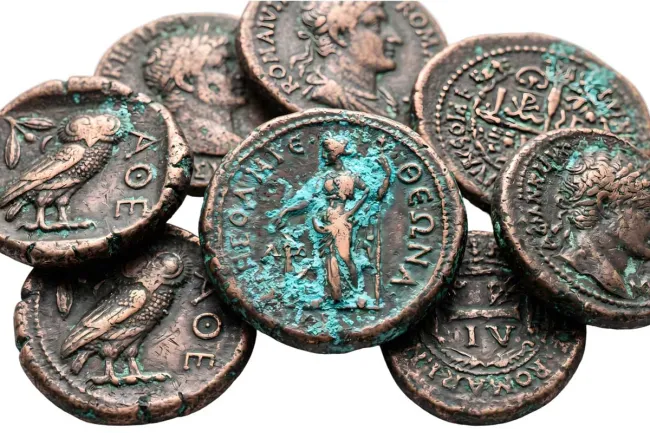
- Alongside it in Haverhill: a hands-on display of Victorian stereoscopes and 3D photography, the nineteenth century's own virtual reality, plus Roman coins found at Kedington and pottery from Wixoe, courtesy of the local history museum.
- Newmarket: National Horseracing Museum, 12 to 15 January 2027.
- Mildenhall: Mildenhall Museum has a full set of replicas on show year round and plans a permanent virtual reality version of the dig later in 2027.
- London: the originals are in Room 49 (Roman Britain) at the British Museum, free, open daily.
Why it is worth your £2
Most 'immersive' heritage experiences are a projector and a mood. This one gives you a task, and a task is what makes history stick. You crouch, you dig, you lift a dish that a Roman servant once carried, and the four years on the sideboard suddenly make sense: who would want to give that back?
Go to Haverhill if you can get a slot, Newmarket if you cannot, and then go to Room 49 and see the real thing. In that order, the silver looks different. You will have already held it.
For another exhibition that rethinks how history is shown, see our piece on Arcadia at the Natural History Museum.
This article is for general information and reflects the exhibition as announced by Haverhill Arts Centre, Mildenhall Museum and Suffolk County Council in November 2026. Check dates, times and availability with the venue before you travel.